Green Star Polyps (GSP)
Scientific Name: Pachyclavularia spp. (commonly sold under several names)
Family: Tubiporidae
IUCN Status: Not Evaluated
Research Level: Moderate
📋 Species Snapshot
Region: Indo-Pacific
Adult Size: Forms encrusting colonies; can spread indefinitely under favorable conditions
Habitat: Shallow reef flats and rocky reef surfaces
Lifestyle: Colonial, sessile
Activity: Polyps typically extend during daylight
Diet: Photosynthesis supplemented by suspended plankton and dissolved organics
Reproduction: Colony expansion and broadcast spawning
Lifespan: Potentially indefinite through colony growth
Safety: Mild stinging cells; generally low risk to people
Experience Level: Beginner
📝 Species Description
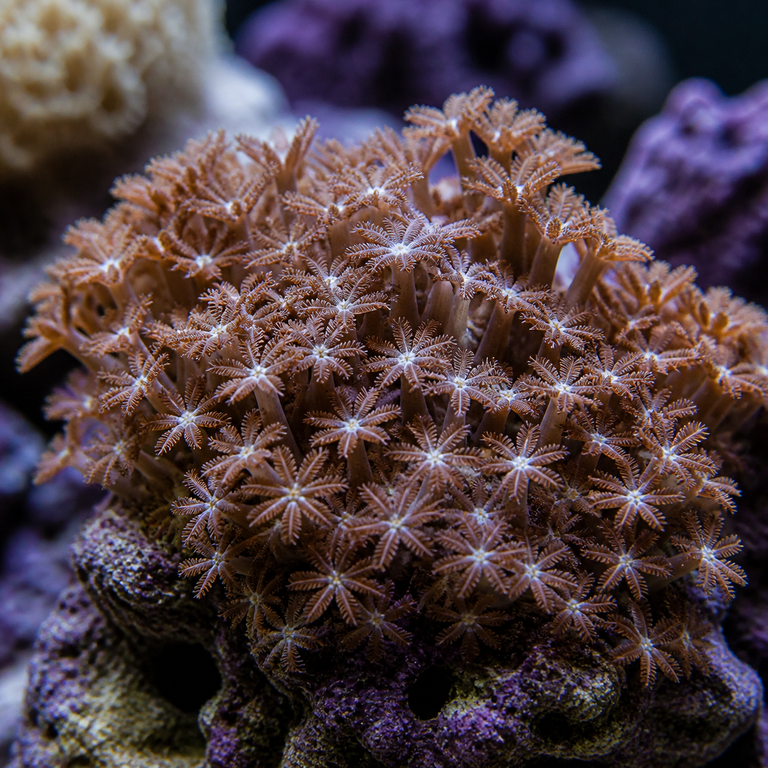
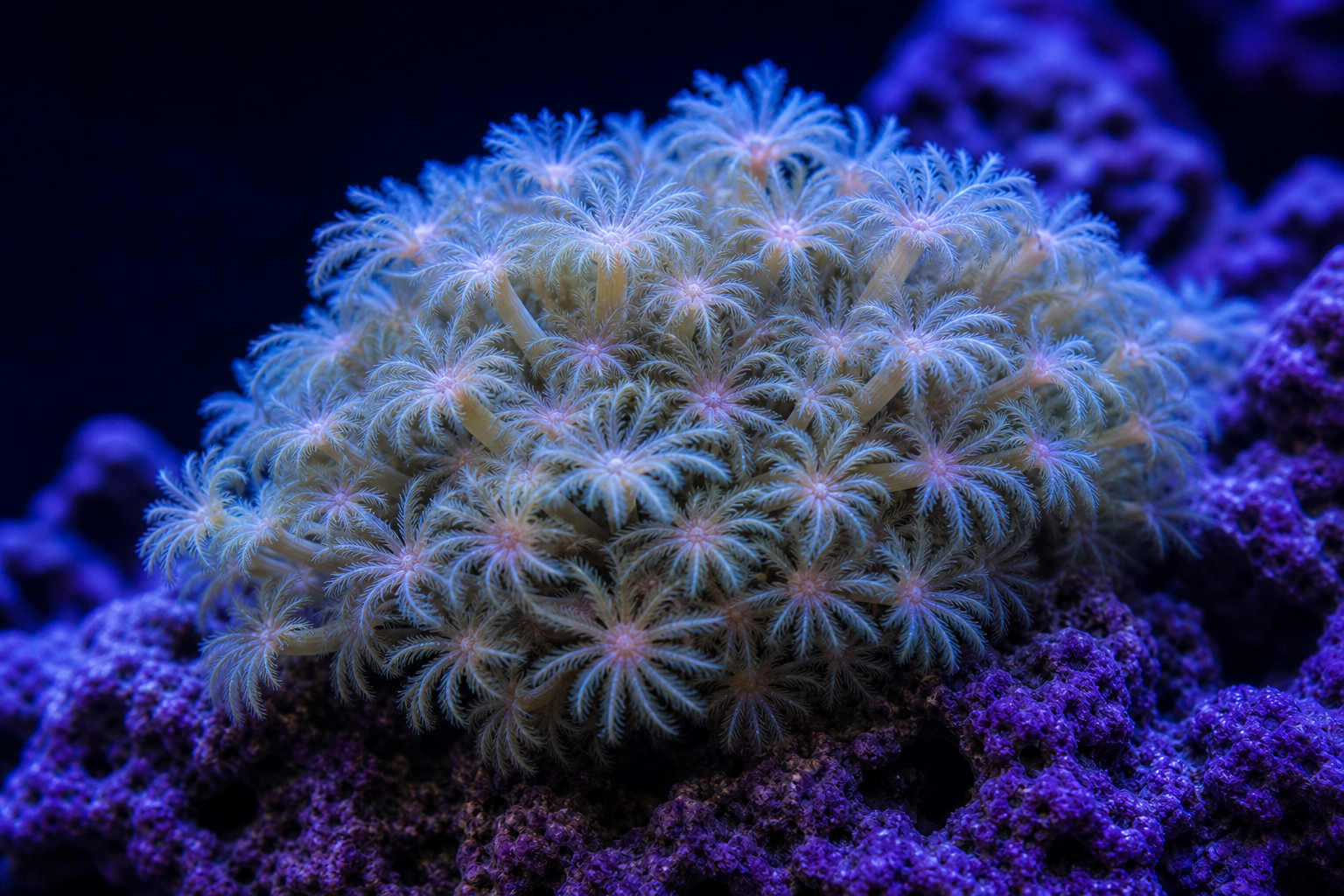
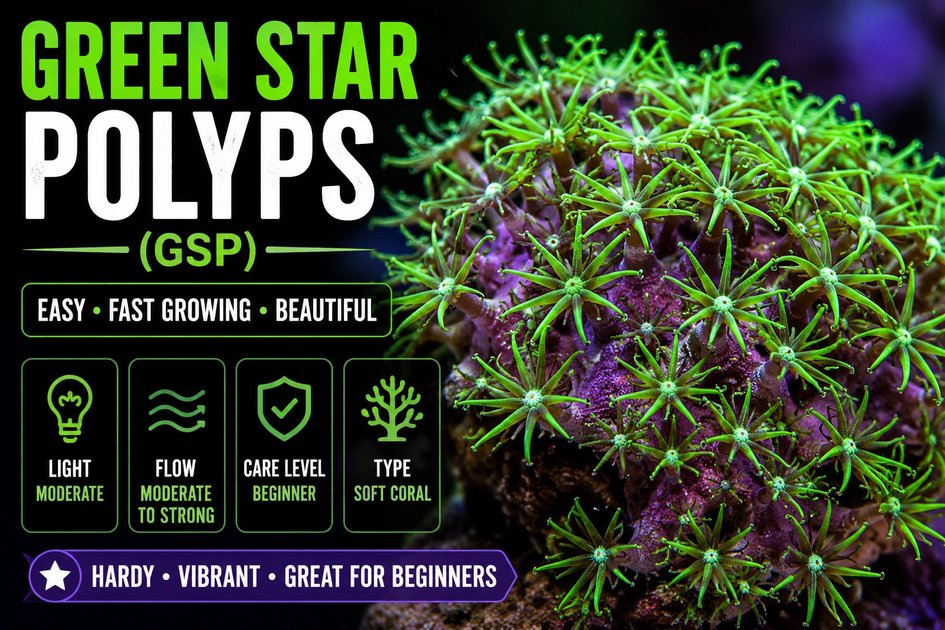
Green Star Polyps are a colonial soft coral that forms colorful mats covered with bright green, grass-like polyps. Individual polyps emerge from a purple or tan encrusting base and retract when disturbed. Their rapid growth and hardiness make them one of the most popular beginner reef corals.
🌎 Overview
Native to shallow Indo-Pacific reefs, Green Star Polyps colonize hard surfaces exposed to moderate water movement. They frequently grow over rock, rubble, and reef structures, forming dense mats that can outcompete slower-growing neighboring organisms.
🌱 Life History
Colonies expand primarily by budding and encrusting onto nearby surfaces. Sexual reproduction occurs through spawning, although this is rarely observed in home aquariums. Individual polyps have relatively short lifespans, but the colony itself can persist for many years through continuous growth.
🎨 Appearance
- Bright green feathery polyps
- Purple to lavender encrusting mat (coenenchyme)
- Polyps retract completely into the mat
- Creates the appearance of flowing underwater grass
🐠 Behavior & Feeding
Natural History
Polyps extend to capture suspended food particles while relying heavily on symbiotic zooxanthellae for energy. Colonies retract rapidly when disturbed.
Husbandry
Thrives under moderate lighting and moderate, turbulent water flow. Readily colonizes rockwork and aquarium structures and may overgrow slower-growing corals if not managed.
🏠 Husbandry
Aquarium Size
- Suitable for most reef aquariums
Lighting
- Moderate
Water Flow
- Moderate to strong, indirect
Placement
- Isolated rock islands are often recommended to control spread.
Water Parameters
- Stable reef parameters
Feeding
- Primarily photosynthetic; supplemental feeding is optional.
Compatibility
- Can overgrow neighboring corals due to rapid growth.
Availability
- Extremely common in the aquarium trade.
📌 Notable Details
- Frequently recommended as one of the best beginner corals.
- Can completely cover rockwork if not managed.
- Polyps sway continuously in current, creating a grass-like appearance.
- Available in several color varieties, including neon green and metallic green.
⭐ Highlights
- Very hardy
- Fast-growing
- Attractive movement
- Beginner friendly
⚠️ Potential Drawbacks
- Can become invasive within a reef aquarium.
- Difficult to remove once established.
- May overgrow slower-growing corals.
- Can temporarily remain closed after changes in water conditions.
🔬 Research Notes
The taxonomy of corals sold as "Green Star Polyps" can be confusing in the aquarium trade, with multiple closely related species and genera sometimes being marketed under the same common name. This makes scientific identification more difficult than for many other commonly kept corals.
📚 References
Primary Literature
Reference Databases
Aquarium References
My takeaway from this test
This one actually exposed something useful. Notice how I naturally wrote Lifestyle: Colonial, sessile instead of trying to force it into terrestrial, arboreal, or fossorial categories.
That tells me the field shouldn't be a fixed list—it should answer "How does this organism live?" The value changes depending on the organism:
- Gulf Coast Toad → Terrestrial, burrowing
- Mozambique Rain Frog → Fossorial
- Green Star Polyps → Colonial, sessile
- Elegance Coral → Solitary polyp, sessile
I think that's a stronger, more universal way to define the field, and it still keeps the template consistent across amphibians, corals, reptiles, fish, plants, and invertebrates